
EU Inc. is Europe's chance to fund physical AI — if member states do not break the standard
· Slush, Helsinki
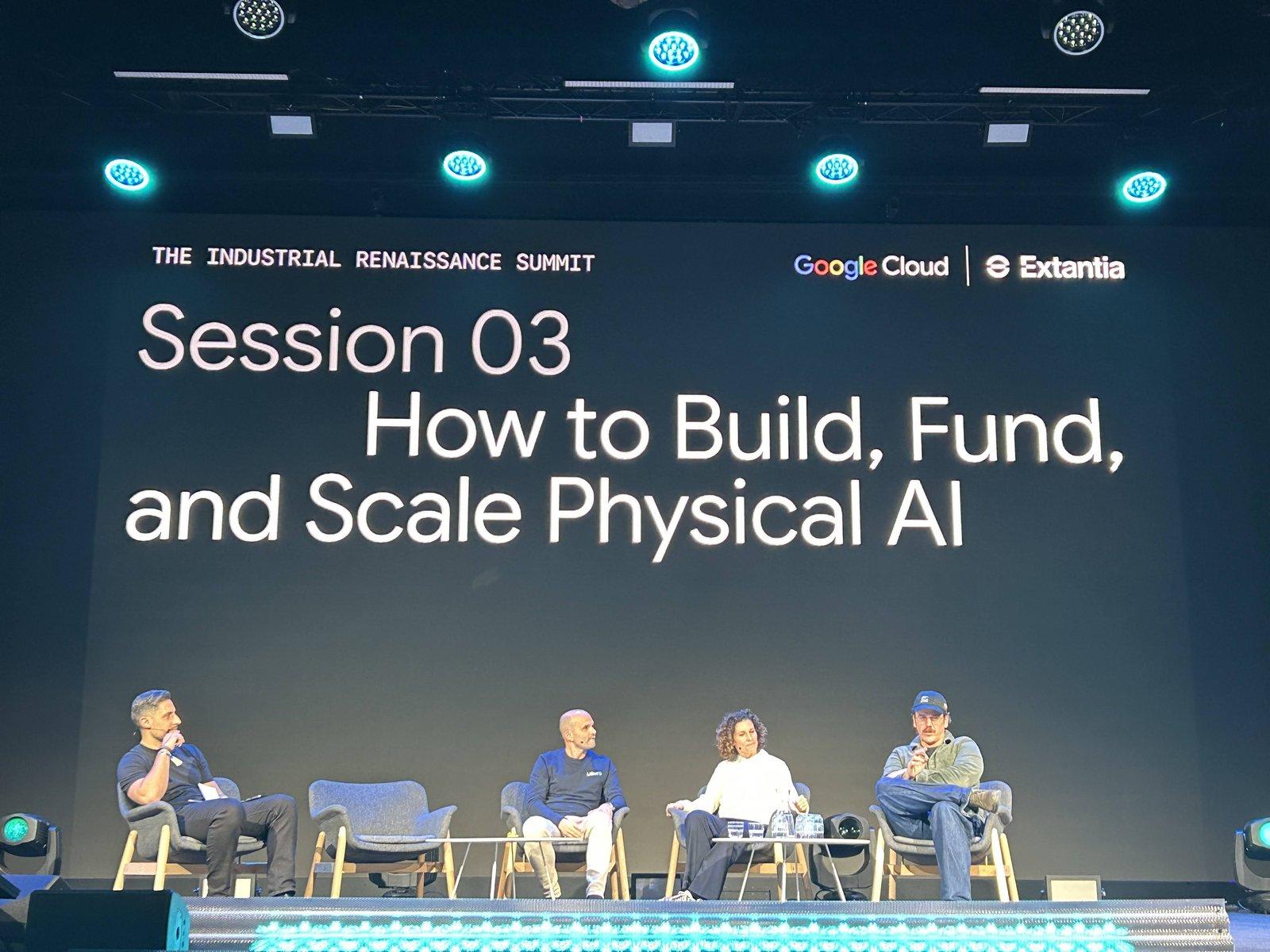
The panel on building, funding and scaling physical AI, moderated by Joseph Michael (Google Cloud), with Andreas Klinger (Prototype), Tom Hubregtsen and Fran Infante (Voltrac), Andreas Kupke (LightQ) and Carlota Ochoa Neven du Mont (Extantia).
Photo: Lars-Fredrik Forberg / Robotics Norway
Robotics Norway president Lars-Fredrik Forberg attended later sessions of the Industrial Renaissance Summit on Thursday 19 November 2026, day 2 of Slush in Helsinki. In the morning sessions, the summit looked at industrial transformation and robots already at work in factories. The later programme turned to how Europe builds, funds and scales physical AI. On that panel, Andreas Klinger of Prototype argued that EU Inc., a proposed European company standard, should make it possible for founders to raise capital globally from day one, and warned that a change added by Council member states could break the core idea. Norwegian robotics founders should follow the proposal closely.
How to build, fund and scale physical AI
The panel, How to Build, Fund, and Scale Physical AI, was moderated by Joseph Michael of Google Cloud. The panelists were Andreas Klinger of Prototype, Tom Hubregtsen and Fran Infante of Voltrac, Andreas Kupke of LightQ, and Carlota Ochoa Neven du Mont of Extantia.
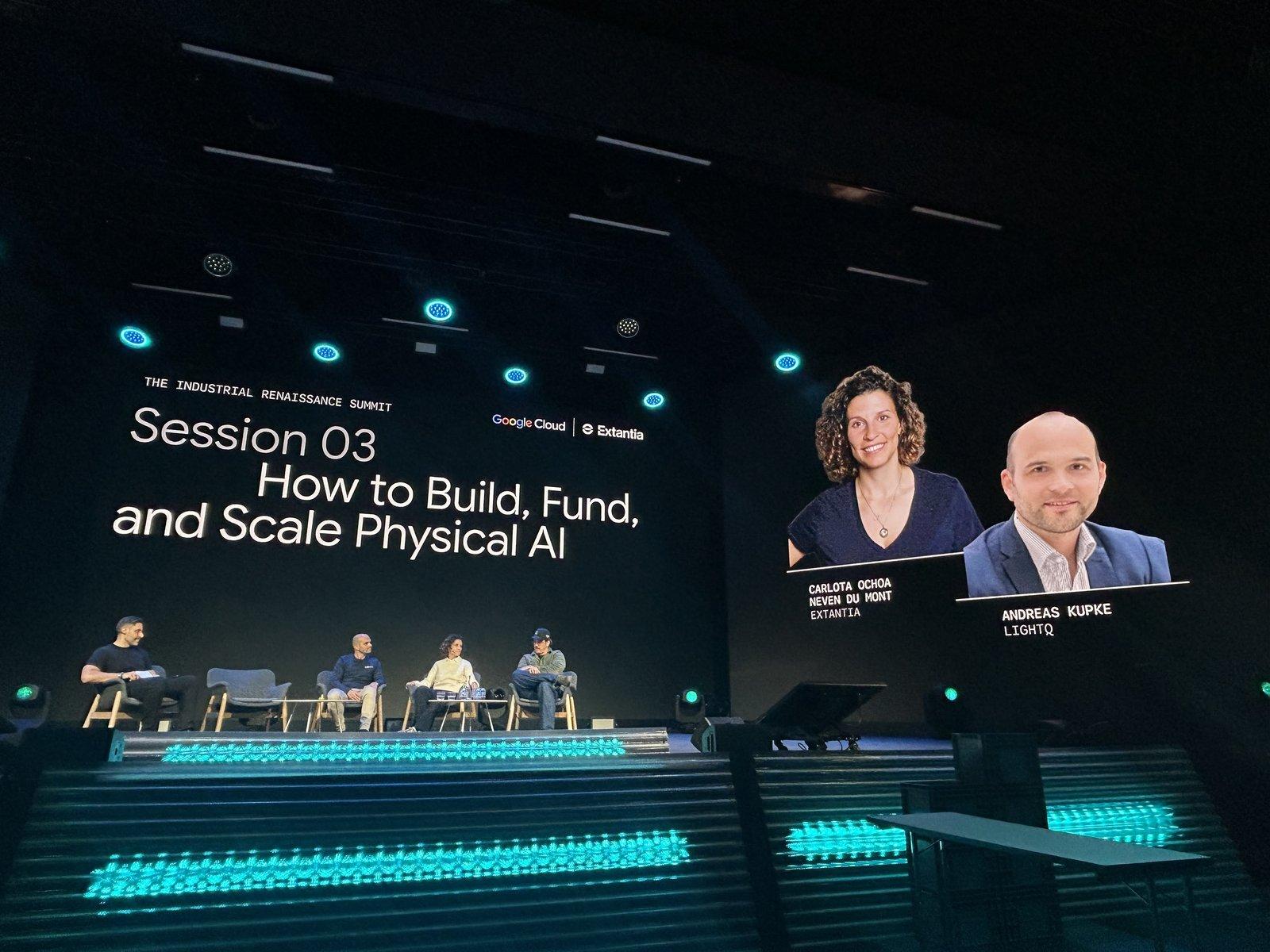
Carlota Ochoa Neven du Mont (Extantia) and Andreas Kupke (LightQ) on the panel.
Photo: Lars-Fredrik Forberg / Robotics Norway
Asked to rate end-to-end automation of a manufacturing plant on a scale of one to ten, Fran of Voltrac gave a seven, Tom a four, and Klinger a nine, but only for highly constrained use cases. Serial and automotive manufacturing is close to fully automatable today, the panelists said, while dynamic, unstructured environments are still years away, and household robots doing general tasks were described as "pure marketing," three to five years out. Doing a backflip is easier than grabbing a glass: a backflip depends on the robot's own actuators and a single policy, whereas grasping requires dynamic perception and adaptation.
Physical AI is having its moment, the panel argued, because software breakthroughs in computer vision and reasoning over the last two to five years now make it possible to go from a photo to video, to a 3D scene, to simulation, to predicted actions. Prototyping automation with a camera, Claude or ChatGPT, and a hardware loop "wasn't possible even half a year ago." One speaker called that "completely insane." Hardware iteration has compressed as well. China's clean-tech boom deepened supply chains for batteries, actuators and components, costs have fallen, and electrification has made machines energy-viable. Vertical integration now takes far less capital. Voltrac described going from concept to architecture in three days, against two months previously, with major components, suppliers and renders in two to three days using AI. LightQ said photonic chip design can now be done in two hours, against two to three years with 3,000 engineers, with AI used across idea, design, engineering, verification and tape-out.
The main bottlenecks, they said, are data for autonomy, sensors such as lidar and radar, and edge compute fast enough for real-time reaction. Kupke described LightQ's work as temporal spectral computing, with light-based compute and memory as one entity, aimed at massive parallelism at high speed and efficiency. Where high autonomy is required, teleoperation still dominates. Fran's view was that time spent performing real tasks is the bottleneck more than data availability.
What investors want, and why EU Inc. matters
Physical AI investment reached 50 billion dollars this year, five times the level of two years ago, a figure also cited in the morning session. Hardware is now attractive to venture investors, the panel said, because software ideas are easy to replicate with AI, while hardware has engineering moats, more predictable timelines, and problems of one or two orders of magnitude to solve. Results in this "frontier tech," as opposed to deep tech, are visible within two to five years, which fits a venture window. The physical AI category will likely fragment next year, as climate tech once did, and hardware and software will stop being treated as separate categories. Ochoa Neven du Mont said the ChatGPT moment for physical AI is still one to two years away. Capital into hardware will grow ten times or more, with Europe's re-industrialisation as a driver.
Klinger put the moat in blunt terms: "Obsession, ambition, and bias to action is a moat. Everything else is a note in a pitch deck." On diligence, he said: "If they need a spreadsheet to convince me, they already lost me." Investors, the panel said, look for a deep technical team paired with a commercial founder who has an execution track record, obsession with one field when it was "uncool," and full-stack thinking that uses a point solution as a wedge but aims to rethink an industry. Voltrac was cited as a talent combination that sounds like a joke: a defence and aerospace engineer and a quantum machine-learning engineer from Google, building a tractor. Long tenure and a cohesive culture matter especially in deep tech; Synapticon was cited as having average tenure of more than six years, with many people staying more than ten.
Klinger also made a political case for EU Inc., a grassroots movement to create a standard that lets founders fundraise globally from day one. It is now a formal European Commission proposal, he said, supported by the president, the Commission and prime ministers. The risk, as he described it, is that Council member states have added a change allowing free choice of registration, which would remove the standard hub and break the core idea. He argued for slowing the process and fixing it before a final vote, and appealed to the room: "If you're friends with a Finance Minister or Justice Minister, please reach out." The proposal is aimed at founders in EU member states. Norwegian robotics founders should follow it, because how Europe makes it easy, or hard, to build and fund physical AI companies will shape the market they operate in.
Robots learning on the job
Nikolai Ensslen of Vesoma spoke with Yair Reem of Extantia in a session titled The New Workforce: Robots Learning on the Job.
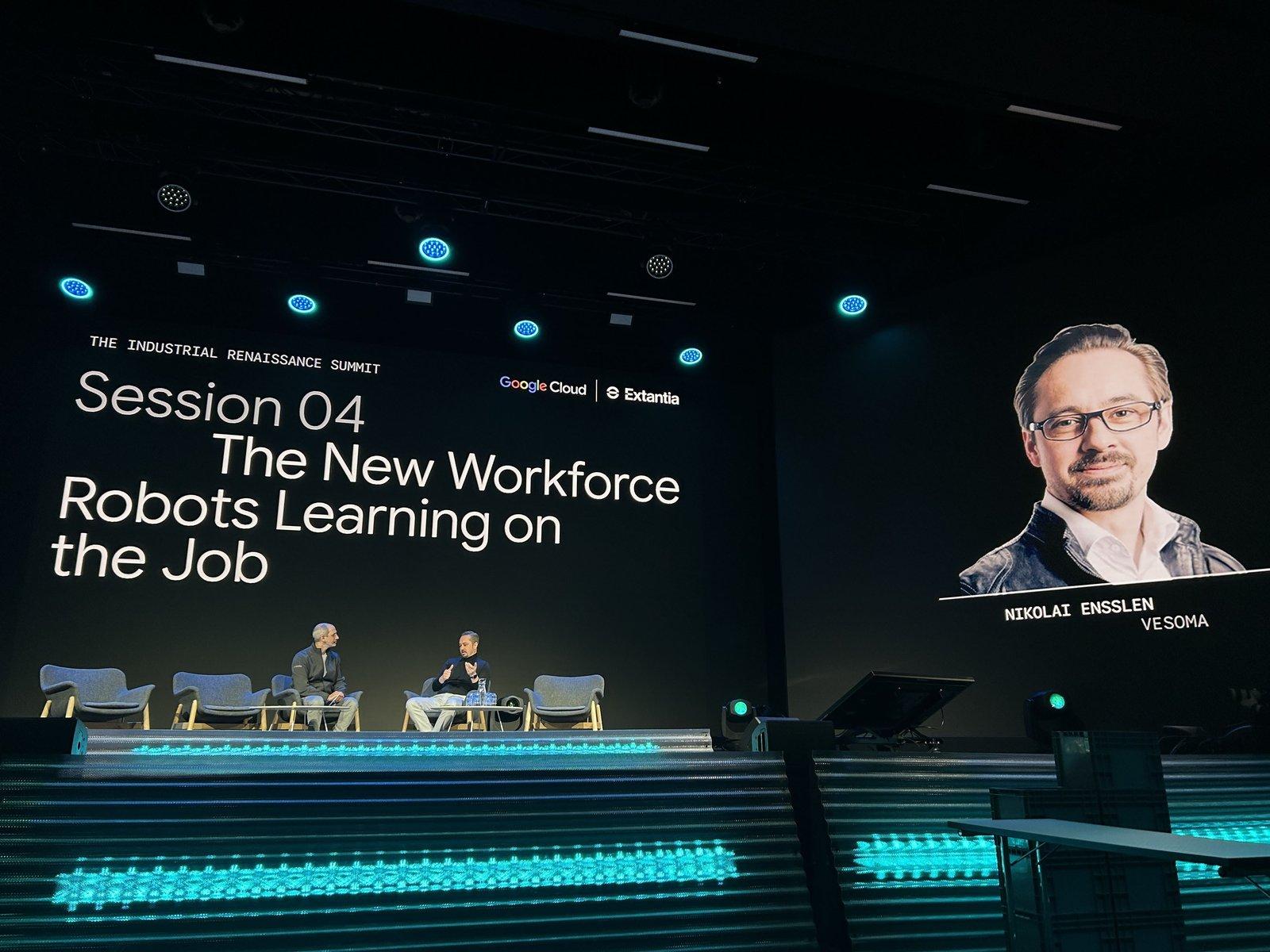
Nikolai Ensslen (Vesoma) in conversation with Yair Reem (Extantia) about robots learning on the job.
Photo: Lars-Fredrik Forberg / Robotics Norway
Ensslen's thesis is that supervised and imitation learning cannot scale to physical AI. The physical world is orders of magnitude larger than language, he said, and would need 24 million times more data than large language models required. Simulation has the same triviality problem. Self-learning through reinforcement learning is the point. "Hands are the reason we're intelligent," he said; embodied learning is the key. Models such as Astra reason well, he argued, but are too slow for physical execution.
He contrasted a skill-based approach with vision-language-action models. A VLA model can train 500 times on a screwdriver and still not know it can use one, he said, while a reinforcement-learning agent may find 500 ways that do not work, but generalises once it finds what does. Reinforcement learning is data-inefficient but far more performant, at over four times the speed of state-of-the-art VLA. In Vesoma's setup, vision-language models instruct the reinforcement-learning agent what to practise, with no human in the loop. A robot learned to walk in three hours, not six months, through sim-to-real transfer, with a natural gait self-learned by AI rather than motion-captured from humans. Hand skills were also shown: the motion was awkward, but faster and with a higher success rate than imitation.
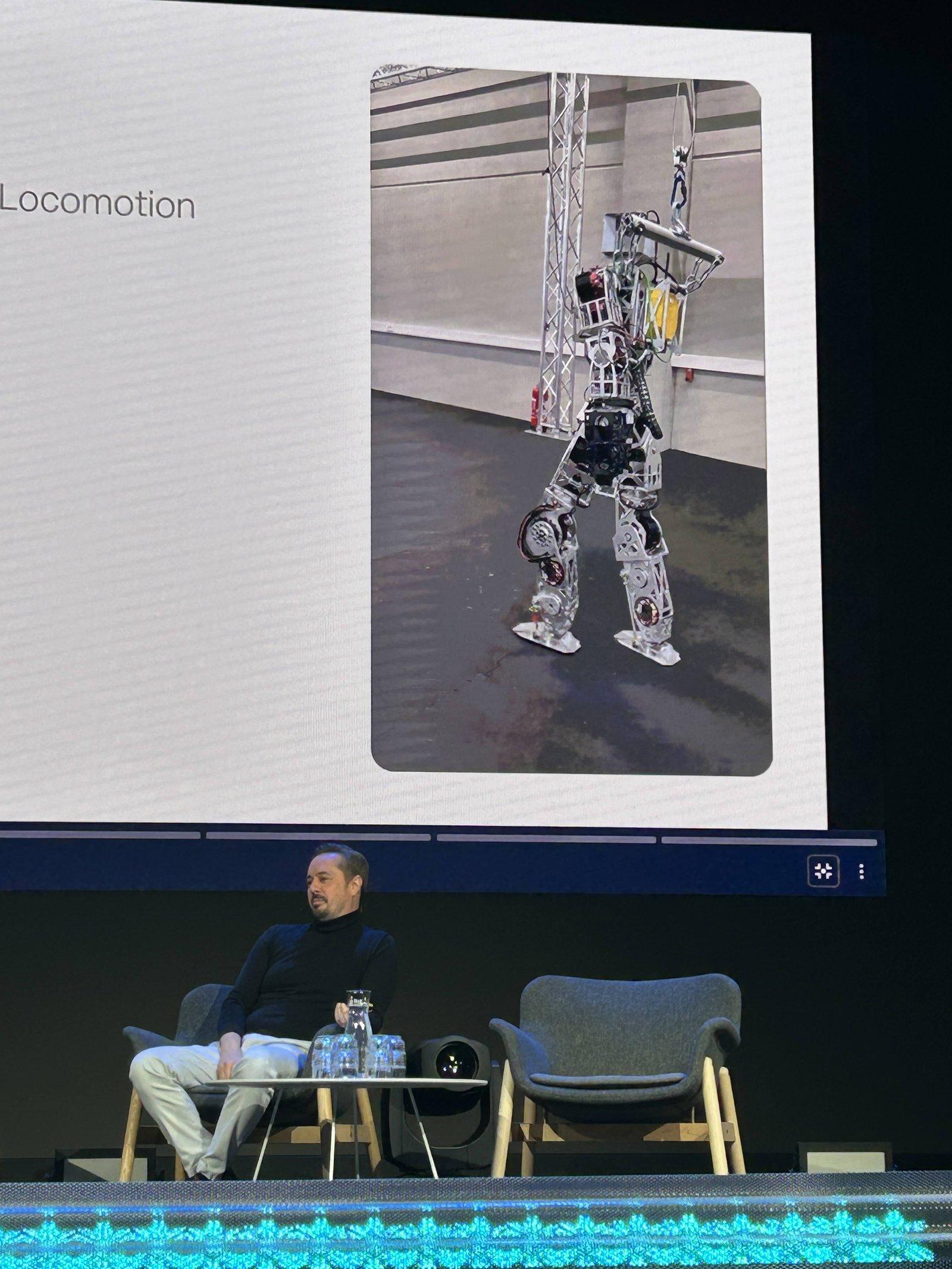
Nikolai Ensslen (Vesoma) on how a robot learned to walk in three hours rather than six months.
Photo: Lars-Fredrik Forberg / Robotics Norway
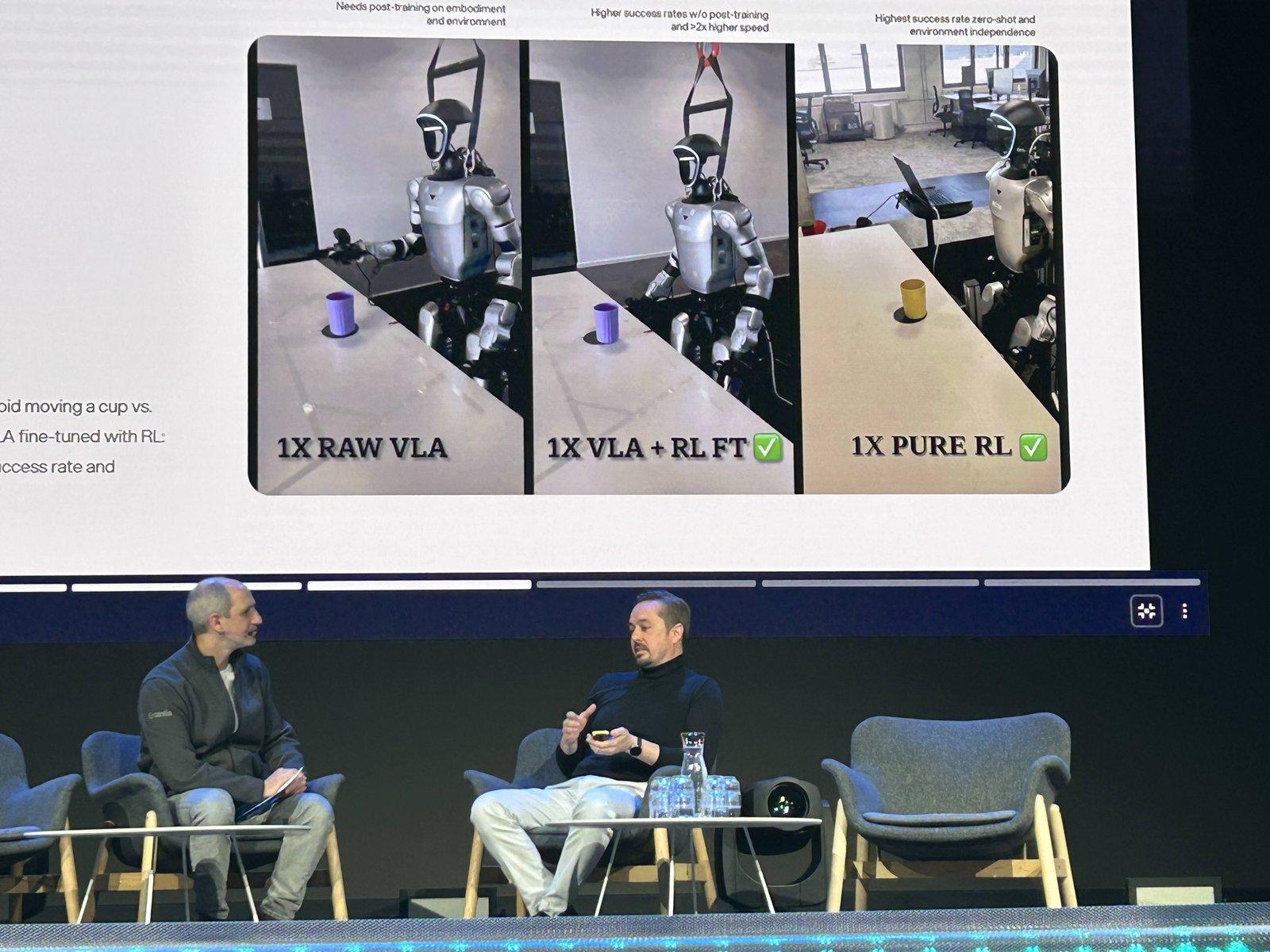
Nikolai Ensslen (Vesoma) argues that reinforcement learning outperforms vision-language-action models for physical skills.
Photo: Lars-Fredrik Forberg / Robotics Norway
Vesoma is testing on a third-party Unitree G1 and plans to launch its own hardware, Vesoma 1, in a few weeks. Ensslen's target is robotic labour at scale solved within 12 months, and a mass-producible product by 2028, starting with manufacturing and logistics. His commitment: "Next year, Model 1 will sit next to me on stage."
On Europe and China, Ensslen described China as a supply-chain accelerator, not only a competitor. Before Covid, he said, China needed the West; since then, China sells to the West. Vesoma blends sourcing, using Chinese factories for speed and cost and European ones for technology and reliability. "Substantial innovation still comes from Europe and the US." Vesoma is bringing senior European talent back from the United States and Asia, including a head of design, Marcelo, who designed Tesla Optimus Gen 3, Cartwheel Yogi and Actronic Apollo, a co-founder from DeepMind in London, and Martin Lindner, described as one of the fathers of reinforcement learning, heading AI.
The panel also argued that Europe's manufacturing muscle is underestimated, in Germany, Eastern Europe and among hidden champions, and that a deep laser and photonics ecosystem in Hamburg, with 3,000 research scientists on campus, is little known even locally. "We are so bad at marketing," one speaker said. There is also a cultural problem: in Europe, researchers who start companies are seen as having "failed." Voltrac said it was proud to build in Europe, citing farming clients, EU tailwinds, and access to tooling and talent.
Closing words
Sebastian Heitmann of Extantia and Itxaso Araque of Google closed the summit. The tone has changed, they said: founders are talking about customers, leasing models and insurance, and robots at work, not only demo videos. It is "not science fiction anymore." The workforce story is that robots are replacing jobs that no longer have people, not displacing workers. Europe's fragmentation was reframed as a strength: smaller, specialised producers can compete precisely because of it. The hardest step, left open for the networking that followed, is going from a lab model to a robot that can run a full factory shift.
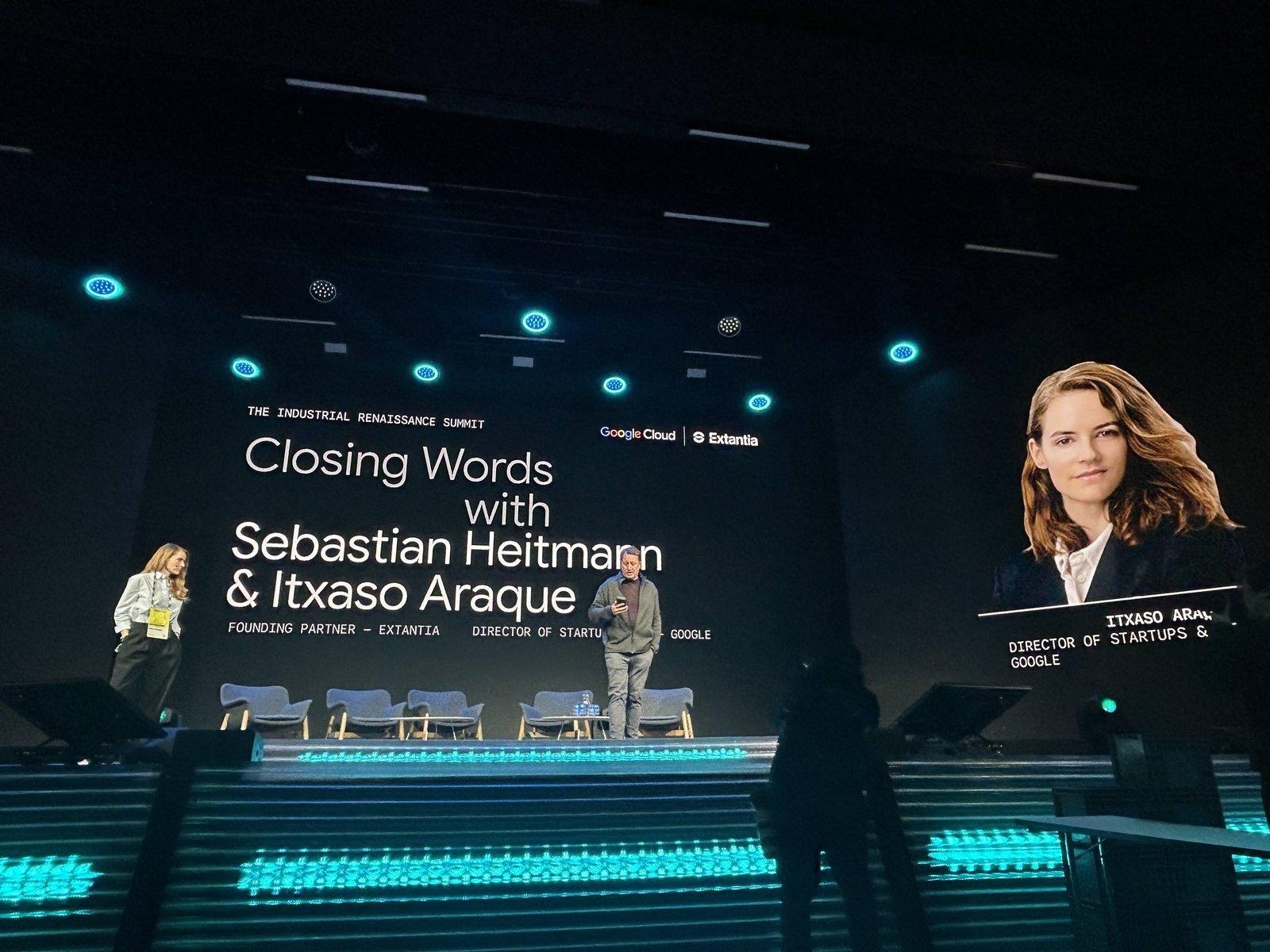
Sebastian Heitmann (Extantia) and Itxaso Araque (Google) close the Industrial Renaissance Summit.
Photo: Lars-Fredrik Forberg / Robotics Norway